

Artificial intelligence didn’t just tiptoe into cybersecurity; it crashed the party because the old ways couldn’t keep up. There were too many attacks—fast, sneaky, overwhelming. Human teams got buried in logs and ignored alerts, and threats found their way in while everyone played catch-up. That’s the gap AI filled. Nobody’s calling it magic, but it does what humans simply can’t: it scans patterns, catches odd behavior, and reacts almost instantly.
Still, it’s not perfect. It makes mistakes, sometimes odd ones. But it changes the pace of defense. That’s the real shift. In this blog, we break down how AI is reshaping data protection, what makes it different, why it matters, and where it’s heading next.
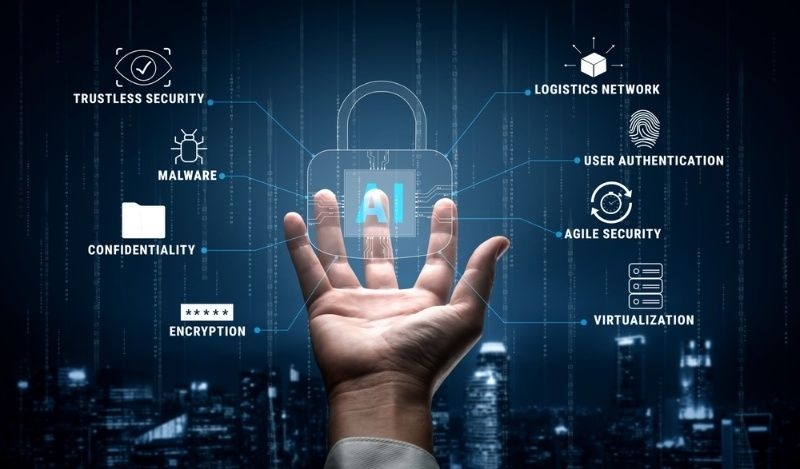
Traditional security tools mostly followed rules. If X happens, trigger Y. Simple. But attackers don’t stay predictable. They shift patterns, disguise behavior, and blend in. Rule-based systems miss that.
AI doesn’t rely only on rules. It studies behavior — network traffic, user actions, and login times. Then builds a baseline. Anything off-pattern gets flagged. Not always perfectly, but often faster.
Older systems relied on known attack signatures. So they only caught threats they already knew. AI sees things differently. It can flag something totally new—like a massive 3 a.m. data download from a strange device—not because it’s on a list, but because it’s weird. That’s a game-changer.
Sometimes speed matters more than perfection. If a breach goes unnoticed for hours, you’re in trouble. AI can act in seconds. It isolates devices, blocks traffic, and fires off alerts—quick and sometimes messy, but better than waiting around. Sure, you’ll get some false alarms, but a little noise beats a big disaster.
There’s just too much data for people to handle: endless logs, countless alerts, and behavior records. AI chews through all that non-stop, no coffee breaks needed. It connects dots at a scale nobody else can manage, turning chaos into something halfway useful.
Also Read: Cloud Data Security: How Businesses Protect Cloud Data
Threats aren’t what they were even a few years ago. Attacks are faster, hackers use AI too, and you just can’t outwork the machines anymore.
Mid-sized companies, sometimes even small ones, get hammered with thousands of attacks every day. No human team can keep up with that. AI cuts through the noise, highlights what really matters, and makes things manageable—even if it’s not perfect.
Phishing used to be obvious—bad grammar, wonky links. Not anymore. Now, they’re targeted, clever, and almost convincing. AI hunts for subtle tells—things like a weird sender, tiny anomalies in writing, timing, or behavior. It’s not magic, but it helps.
Analysts burn out chasing endless alerts and working long hours. Mistakes are inevitable when you’re exhausted. AI picks up boring, repetitive tasks, handles the grunt work, and lets people focus on actual strategy and analysis. It’s not about replacing humans—just helping them breathe again.
It’s more than just speed. AI’s approach is different. The old system waits for instructions. AI figures stuff out for itself.
Rule-based systems need constant updates. There’s a new threat? Somebody writes a new rule. AI keeps learning as it goes, adjusting to patterns without manual input. That gives you flexibility—but sometimes the results are unpredictable. It’s a tradeoff.
Traditional tools step in after trouble hits. AI looks for warning signs, trying to catch issues before they blow up. It sees patterns—suspicious logins followed by data grabs—and flags them early. It’s about stopping trouble before it starts, at least in theory.
Not all areas get the same boost from AI, but there are some clear wins.
AI notices things you and I wouldn't, like subtle patterns, slight anomalies, and strange connections. You catch more, particularly of unfamiliar threats. It's not perfect, but it's better.
Automated response reduces delay. Instant response stops the virus. No need for human intervention; it happens immediately. Stopping threats, quarantining attacks. Speed becomes defense.
AI monitors transactions in real time, looking for sudden big money moves, location weirdness, or odd spending. Banks and online shops use this all the time. Fraud gets harder, but not impossible.
Don't Miss: What is Data Encryption & Why is it Essential for Security?
AI’s just getting started in cybersecurity. There’s more coming—deeper integration, tighter connections, and new challenges.
AI will enhance zero-trust security, always verifying who is doing what, never trusting because someone is “inside.” Every move is checked, every action scrutinized.
Governments will regulate AI in cybersecurity. Data usage, decision transparency, accountability. Ethical concerns will rise, especially around surveillance and privacy. Rules will tighten. Slowly.
AI hasn’t solved cybersecurity—but it’s changed the whole game. Everything’s faster, sharper, and more adaptive, but also more complicated. Companies now rely on systems they don’t always fully understand. That’s not going away.
Data protection gets better—for now. Detection speeds up, responses are quicker, and patterns are clearer. But risk evolves, too. Attackers adapt. Systems break. Data gets messy.
So, no—AI isn’t the answer. It’s a tool—powerful, flawed, and necessary. The real value is in how people use it, watch it, and fix it when it goes sideways. Balance is everything. That’s where the story’s headed—not people being replaced, but being forced to think differently.
AI doesn't crack encryption, nor does it look at the actual content. Rather, it examines metadata, things like the pattern of traffic, the timing, and the packet size. It identifies anomalies using this information, even when we can't see the data.
Absolutely. For small businesses, this typically involves using cloud or managed security services with AI. They're cheaper than they used to be, but you do need someone to configure and monitor them.
Nope. AI lowers risk, spots trouble quicker, and speeds up your response, but it can’t stop every attacker. Hackers keep evolving, too. AI is just one part of your defense.
You need a basic handle on cybersecurity, and an understanding of data analysis helps a lot. Knowing machine learning principles is useful, but not always required. Most important is being able to make sense of what AI spits out and making smart calls based on that.
This content was created by AI